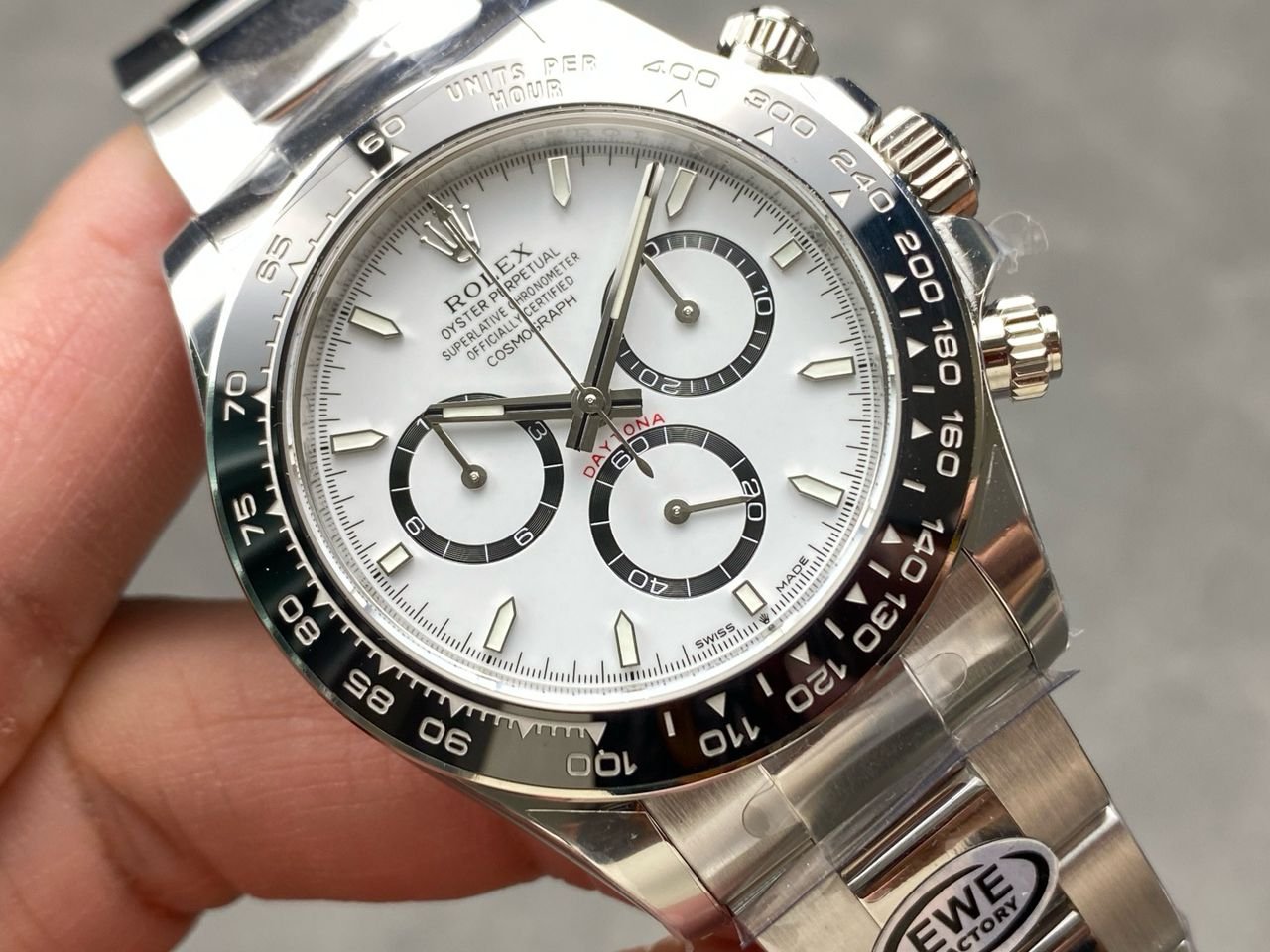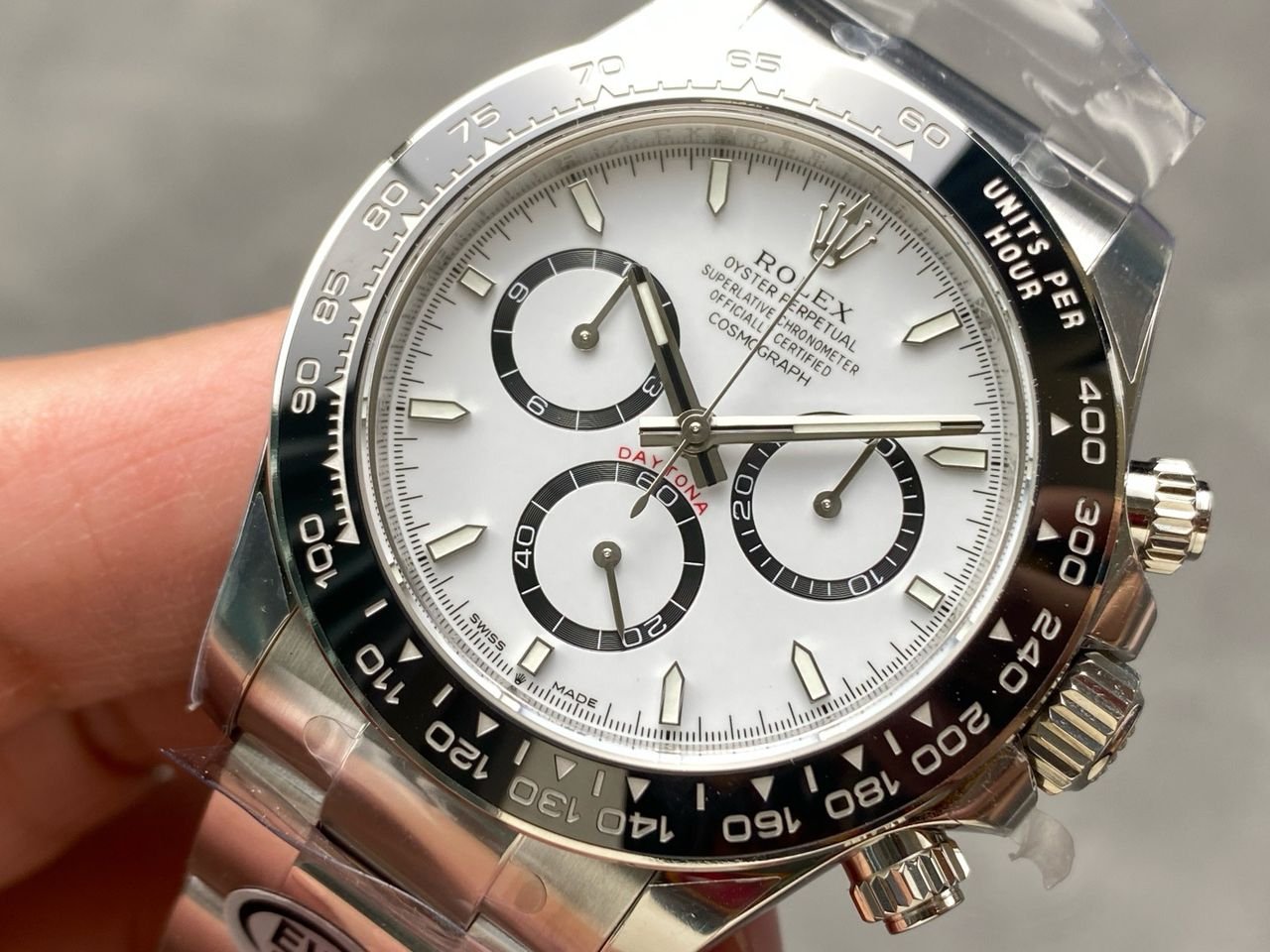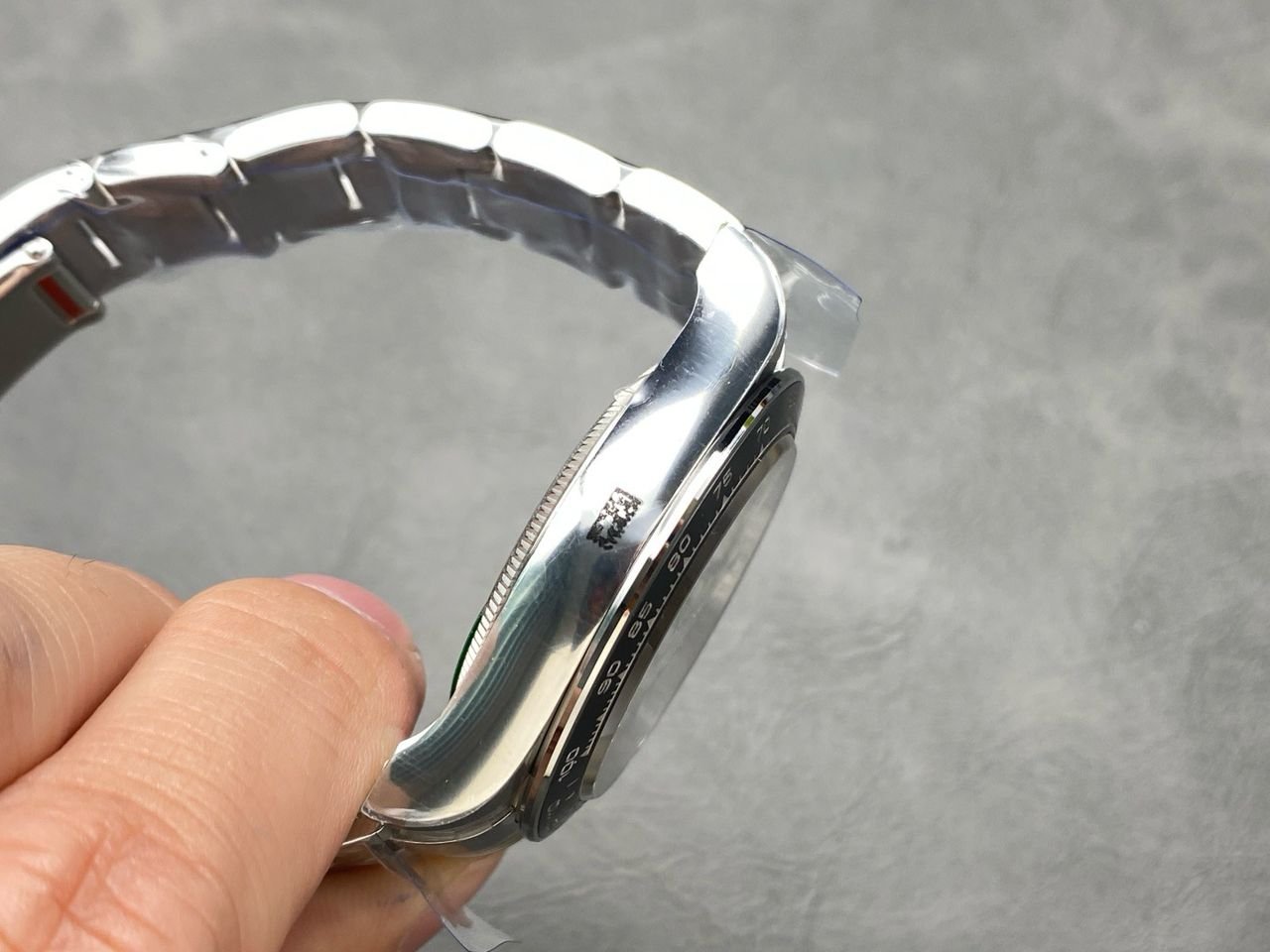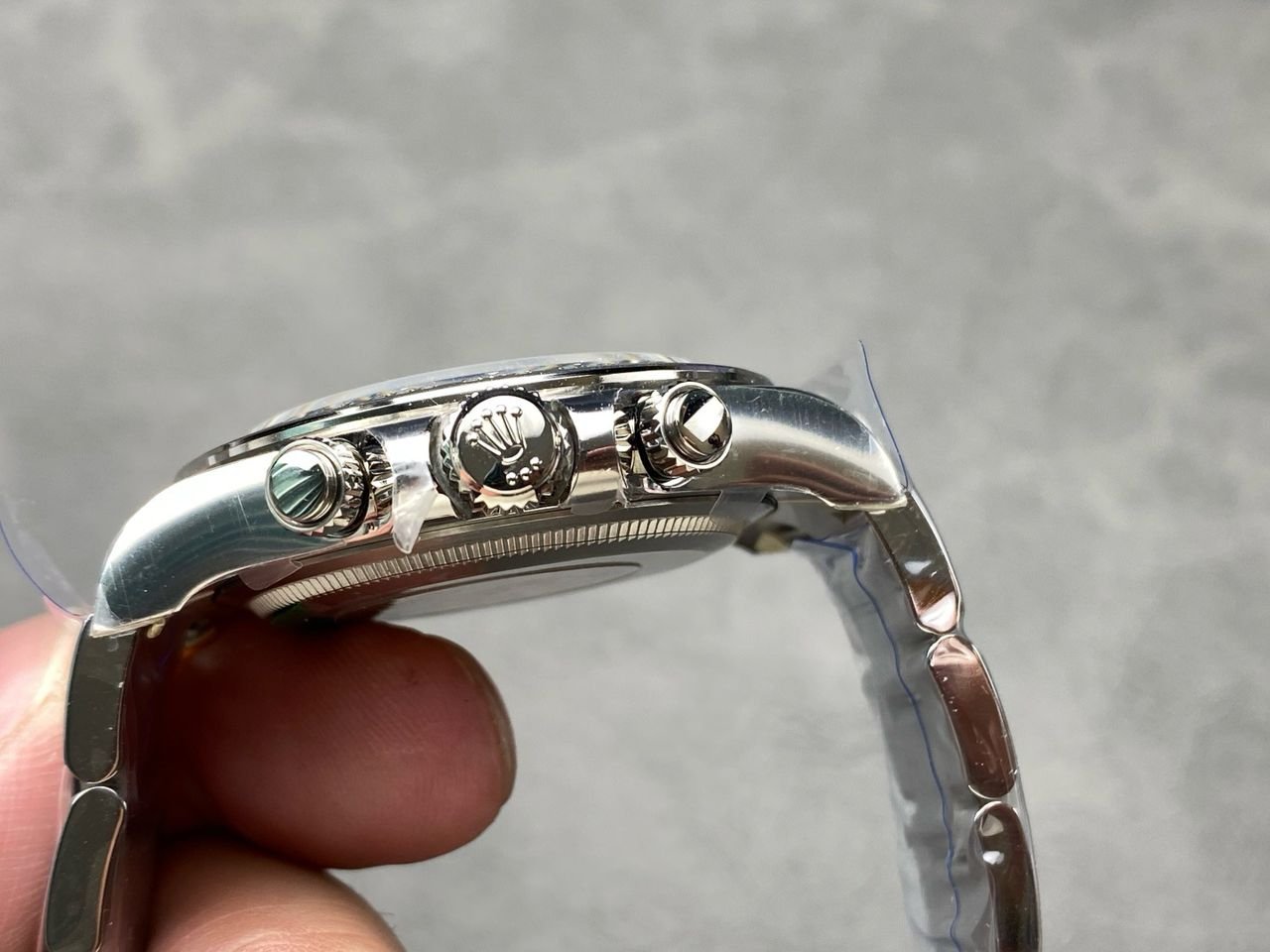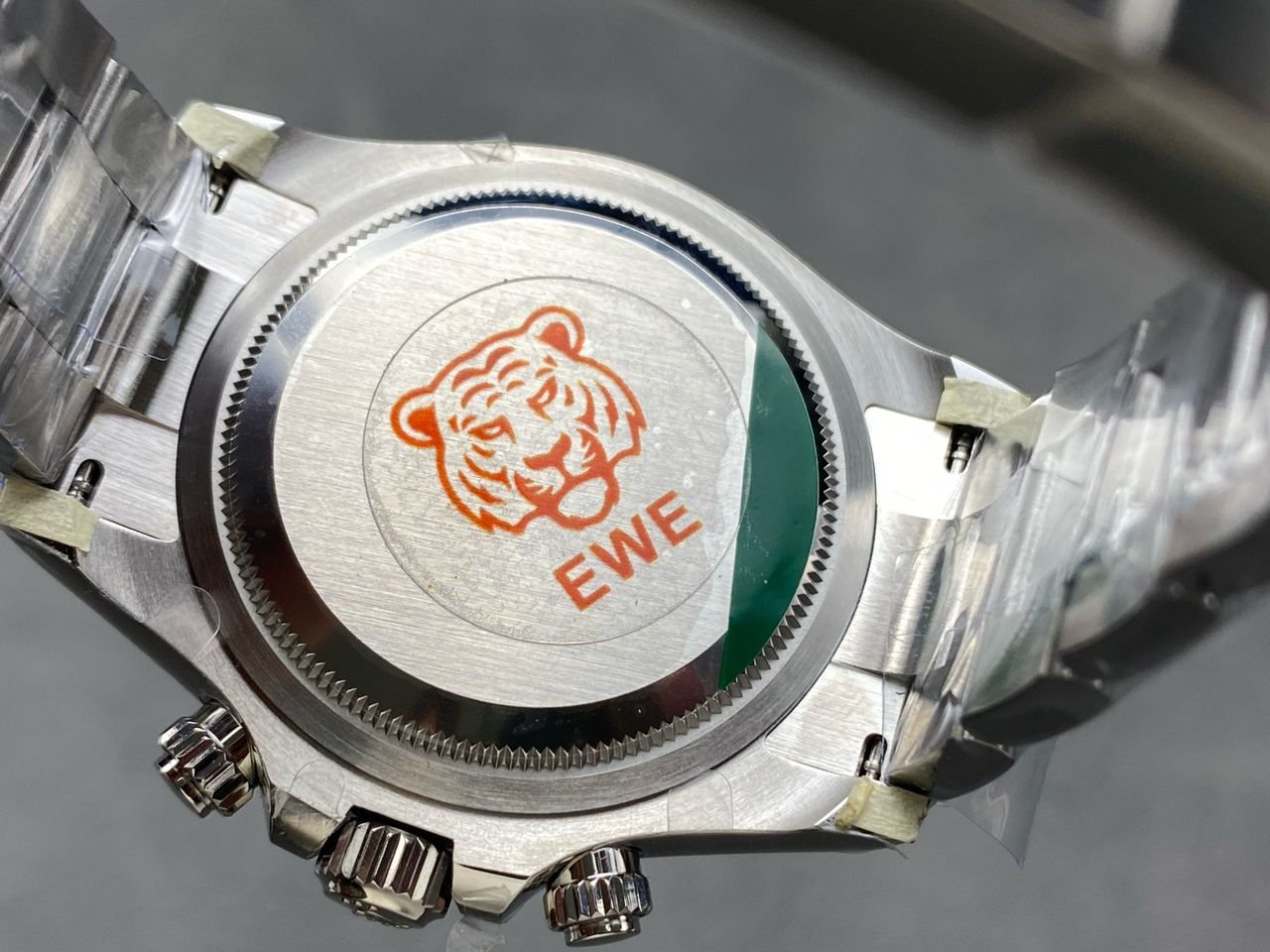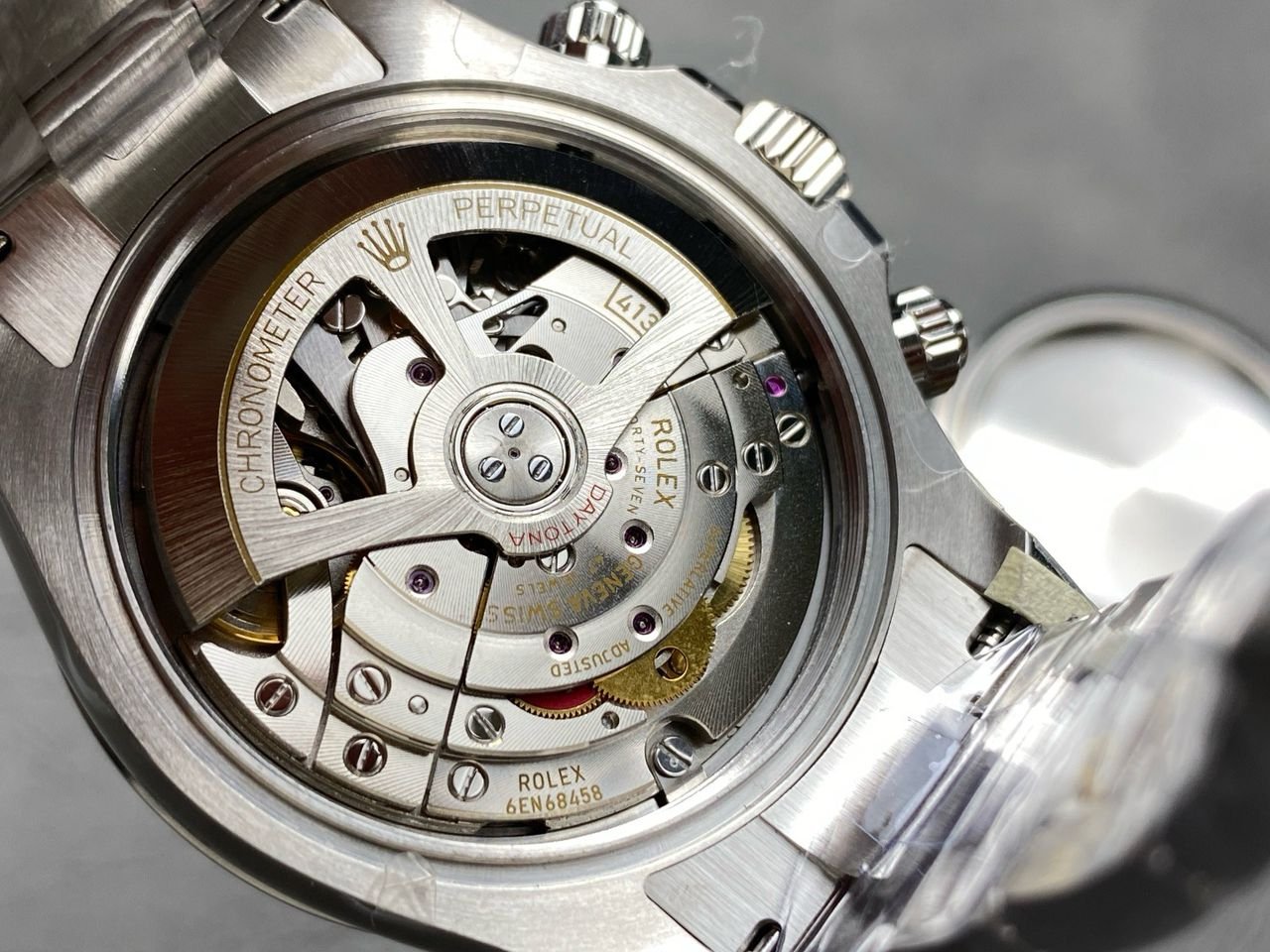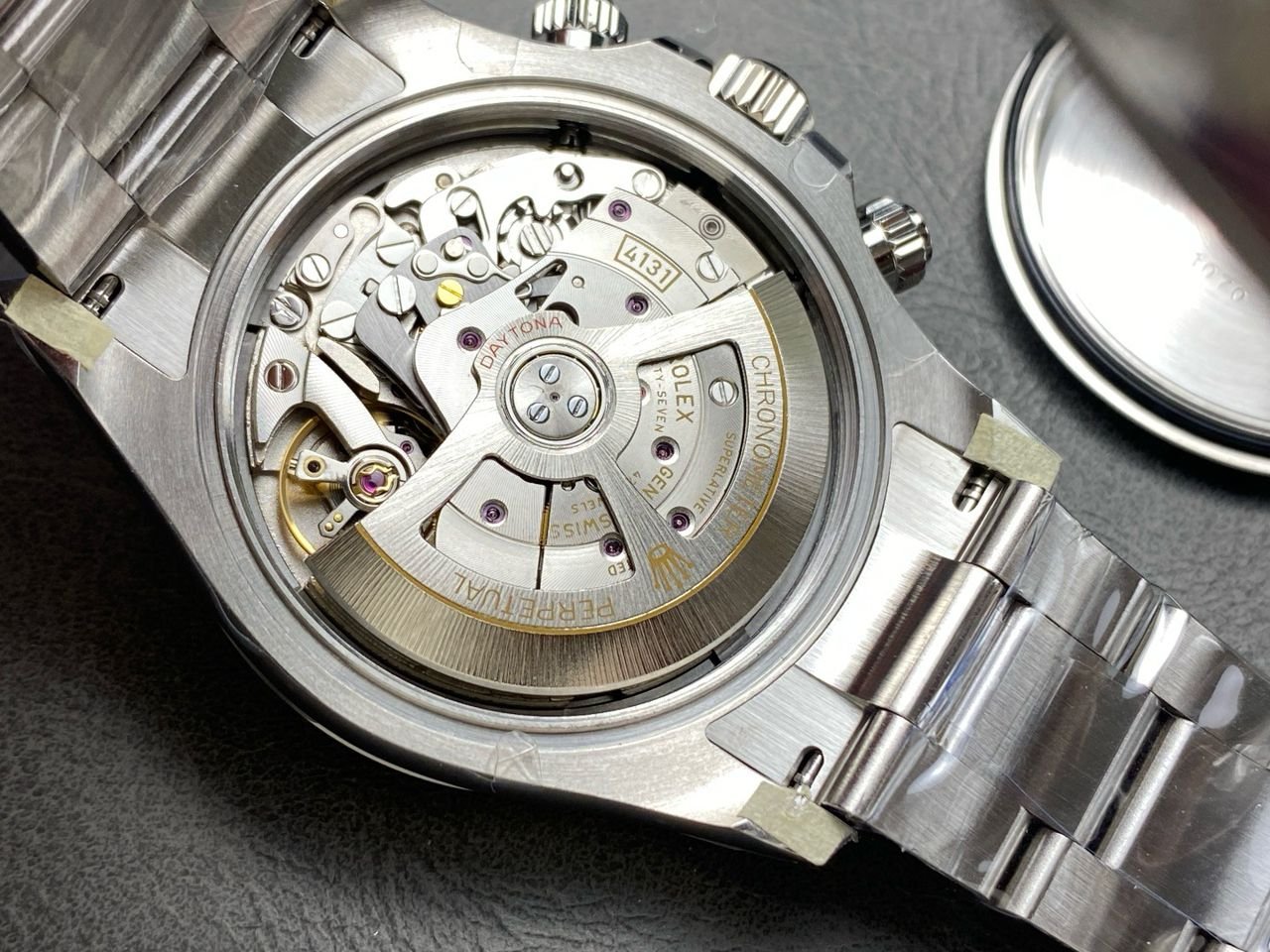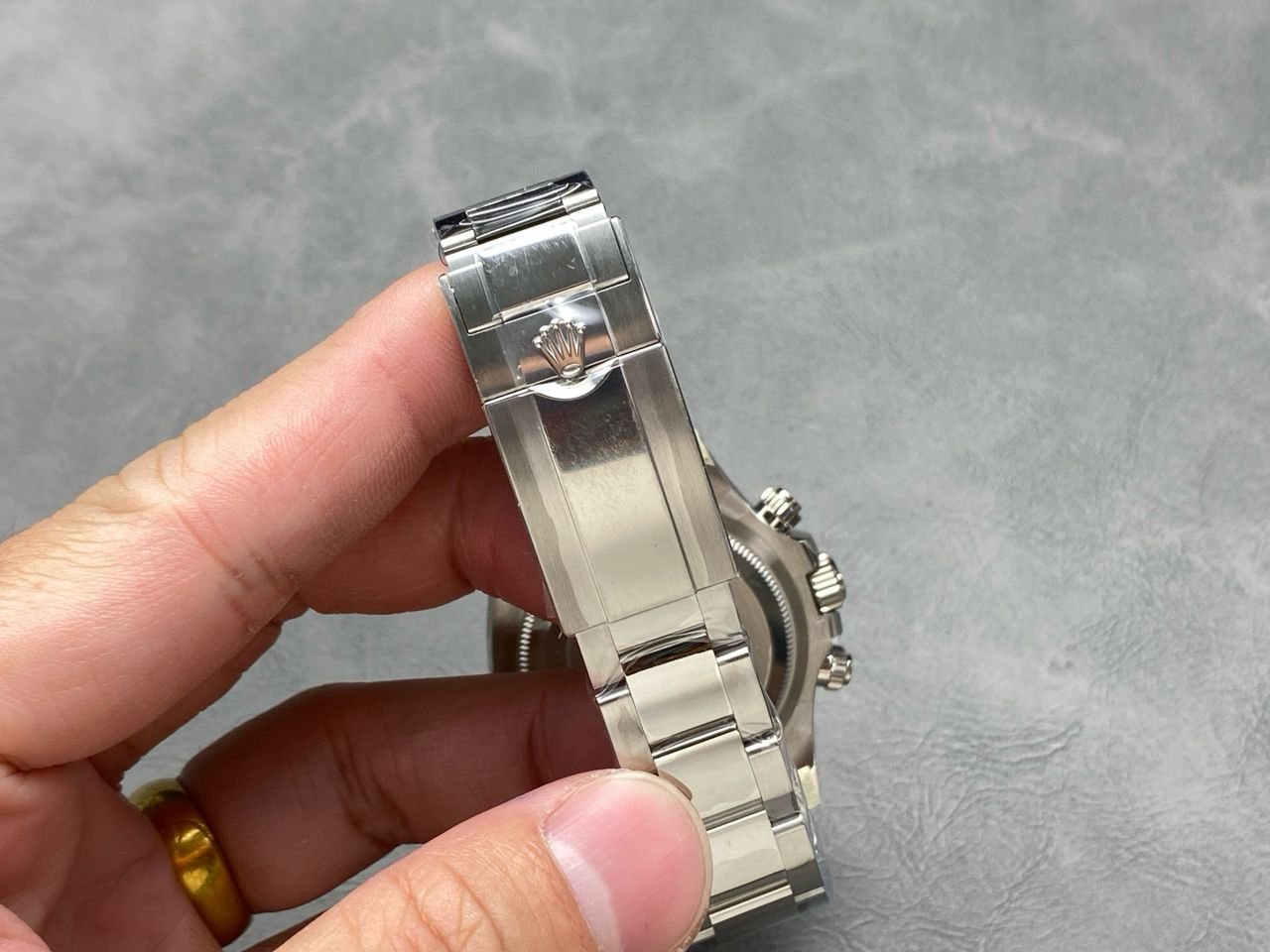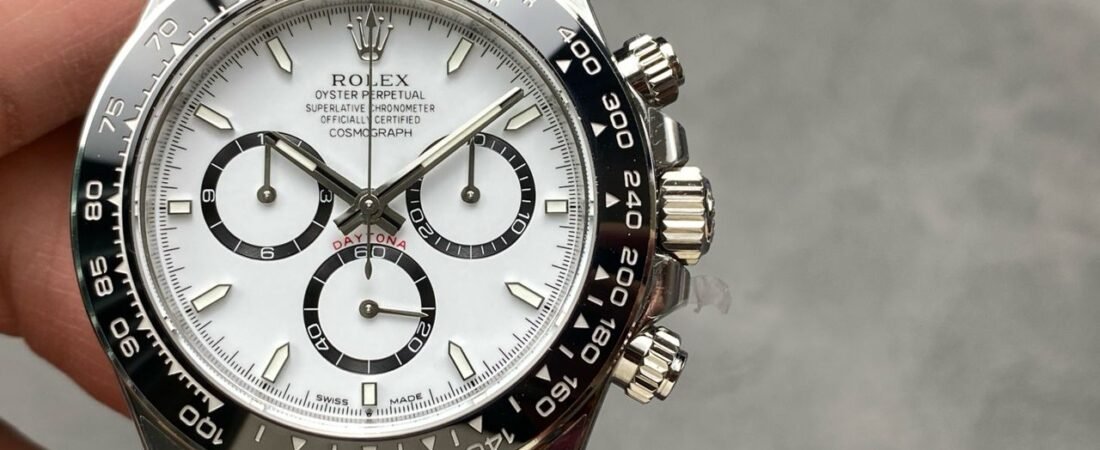
EWE Factory Rolex Daytona 126500 4131 Movement Guide
The EWE Factory Rolex Daytona 126500 is a 40mm automatic chronograph featuring an integrated 4131-style mechanical movement, ceramic bezel and a stated case thickness of approximately 11.9mm.
Black- and white-dial configurations are available.
Compared with earlier 4130-style Daytona configurations, the 126500 generation introduces changes to the movement, dial details, bezel construction and case profile. These characteristics are more useful for technical identification than broad market descriptions such as “super clone watch.”
40 × 11.9mm Case
The supplied EWE specifications list the watch at:
- Case Diameter: 40mm
- Case Thickness: 11.9mm
The factory information states that this configuration is approximately 0.5mm thinner than its previous version.
Because the exact earlier EWE reference measurement was not supplied, 11.9mm should be treated as the primary documented specification rather than assuming that every previous Daytona version measures exactly 12.4mm.
Actual thickness should also be verified during individual QC.
Revised Case Profile
The 126500 generation features a revised case profile, including more pronounced curvature around the lug area.
Case geometry affects both appearance and how the watch sits on the wrist.
Useful macro inspection areas include:
- Lug curvature
- Case symmetry
- Brushed surfaces
- Polished surfaces
- Edge transitions
- Bracelet-to-case alignment
These details can be compared between individual production batches.
Integrated 4131-Style Movement
The principal mechanical feature of this EWE 126500 is its integrated 4131-style automatic chronograph movement.
This distinguishes the current configuration from earlier Daytona-style watches based on 4130 architecture.
For database classification, it can therefore be recorded as:
EWE Factory → Daytona 126500 → 4131-Style Integrated Chronograph
The movement designation should still be separated from actual mechanical performance, which requires individual testing.
Functional Mechanical Chronograph
The supplied information describes the chronograph as mechanically functional rather than decorative.
QC should test the complete operating sequence:
- Start
- Stop
- Reset
- Central Chronograph Seconds
- Chronograph Registers
- Reset-to-Zero Alignment
The chronograph should be allowed to run long enough to confirm register operation rather than testing only the central seconds hand for several seconds.
Two-Position Crown Setting
An important detail in the supplied specifications is the two-position crown-setting configuration.
This is useful when distinguishing the 4131-style movement from some 7750-based chronograph configurations that may use a different crown-setting sequence.
The crown should be tested for:
Winding → Time Setting
The transition between positions should feel clearly defined without excessive resistance.
4130 vs 4131 Generation
The movement update is one of the main technical distinctions between earlier and current Daytona generations.
Feature Earlier Configuration EWE 126500
Movement Generation 4130-Style 4131-Style
Winding Automatic Automatic
Chronograph Mechanical Mechanical
Current Case Thickness — Approx. 11.9mm
Model Generation Earlier Daytona 126500
Dial Details Earlier Layout Revised 126500 Layout
Bezel Construction Earlier Style Revised Metal-Edged Design
The movement change should therefore be considered alongside the exterior changes rather than treating the 126500 as simply a new dial variation.
Revised Hour Markers
The supplied EWE information identifies narrower hour markers as one of the dial changes.
Finer markers slightly change the visual proportions of the dial and create more open space between the individual elements.
During QC, marker thickness should be evaluated together with positioning and alignment.
Revised Chronograph Registers
The chronograph-register details are also described as being more refined and visually slimmer than on the previous generation.
Useful inspection points include:
- Register diameter
- Printing
- Ring thickness
- Hand alignment
- Spacing
- Surface finishing
These small details are particularly useful when comparing macro photographs of different 126500 versions.
Crown Mark at 6 O’Clock
The supplied specification identifies a small crown emblem at the 6 o’clock position.
Because this is a relatively small dial detail, macro photography provides the most useful method for documenting its shape, position and printing quality.
It can also serve as one of several visual identifiers when comparing production generations.
Ceramic Bezel with Metal Outer Edge
The 126500 configuration combines a ceramic bezel insert with a visible metal outer edge.
This creates a different bezel profile from earlier configurations where the ceramic portion visually dominated the entire outer perimeter.
Useful QC points include:
- Ceramic surface
- Numeral filling
- Bezel alignment
- Metal outer edge
- Transition between ceramic and metal
- Surface scratches or chips
The metal perimeter is an important visual identifier of the 126500 generation.
Black and White Dial Versions
The supplied information identifies both:
Black Dial / Black Ceramic Bezel
and
White Dial / Black Ceramic Bezel
These should be stored as separate dial configurations under the same EWE 126500 technical page rather than creating two nearly identical movement articles.
Luminous Hands and Markers
The dial uses luminous hands and hour markers.
Rather than describing the luminous material as a particular proprietary formulation without verification, QC should document observable characteristics such as:
- Lume color
- Application consistency
- Initial brightness
- Marker-to-marker consistency
- Hand-to-marker consistency
This provides measurable visual information without making unsupported material claims.
Why the 11.9mm Measurement Matters
Case thickness is particularly useful when comparing Daytona versions.
A small difference such as 0.5mm may sound insignificant, but thickness affects side profile, case proportions and how closely the watch sits against the wrist.
For this reason, the EWE 126500 should eventually be recorded using three physical measurements:
40mm Diameter × 11.9mm Thickness × Actual QC Weight
The first two are supplied specifications; weight should be added after physical measurement rather than estimated.
What to Check During QC
For an EWE Factory 126500, useful QC records include:
- Actual Weight
- Case Diameter
- Case Thickness
- Daily Rate
- Amplitude
- Beat Error
- Beat Rate
- Power Reserve
- Automatic Winding
- Crown Positions
- Chronograph Start
- Chronograph Stop
- Chronograph Reset
- Reset-to-Zero Alignment
- Subdial Operation
- Dial Alignment
- Hour Marker Alignment
- Ceramic Bezel
- Metal Bezel Edge
- Bracelet and Clasp
These measurements can later be used to compare EWE with other 126500 movement and case configurations.
Technical Specifications
Specification Details
Factory EWE Factory
Model Rolex Daytona 126500 Style
Case Diameter Approx. 40mm
Case Thickness Approx. 11.9mm
Movement Integrated 4131-Style Automatic
Previous Movement Generation 4130-Style
Chronograph Functional Mechanical Chronograph
Crown Setting Two-Position Configuration
Dial Options Black / White
Bezel Ceramic with Metal Outer Edge
Hour Markers Revised Slimmer Style
6 O’Clock Detail Crown Emblem
Weight Not Provided
Frequently Asked Questions
- What movement does the EWE Factory 126500 use?
The supplied specification identifies an integrated 4131-style automatic mechanical chronograph movement.
- How thick is the EWE Daytona 126500?
The supplied case thickness is approximately 11.9mm, with a case diameter of approximately 40mm.
- Does the chronograph function work?
According to the supplied specifications, the chronograph functions are mechanically operational, including start, stop and reset. Individual watches should still be function-tested during QC.
- What does two-position crown setting mean?
The supplied configuration uses a winding and time-setting sequence without the additional crown position commonly encountered on some 7750-based configurations.
- What changed on the 126500 exterior?
Notable supplied changes include slimmer hour markers and chronograph-register details, a crown emblem at 6 o’clock, revised lug curvature and a ceramic bezel surrounded by a metal outer edge.
- Is the EWE 4131 necessarily more reliable than other 4131 movements?
That cannot be established from the supplied information alone. Claims about reliability or repair rates require meaningful long-term failure data. Individual movement performance is better evaluated through timegrapher readings, chronograph testing and longer-term QC records.